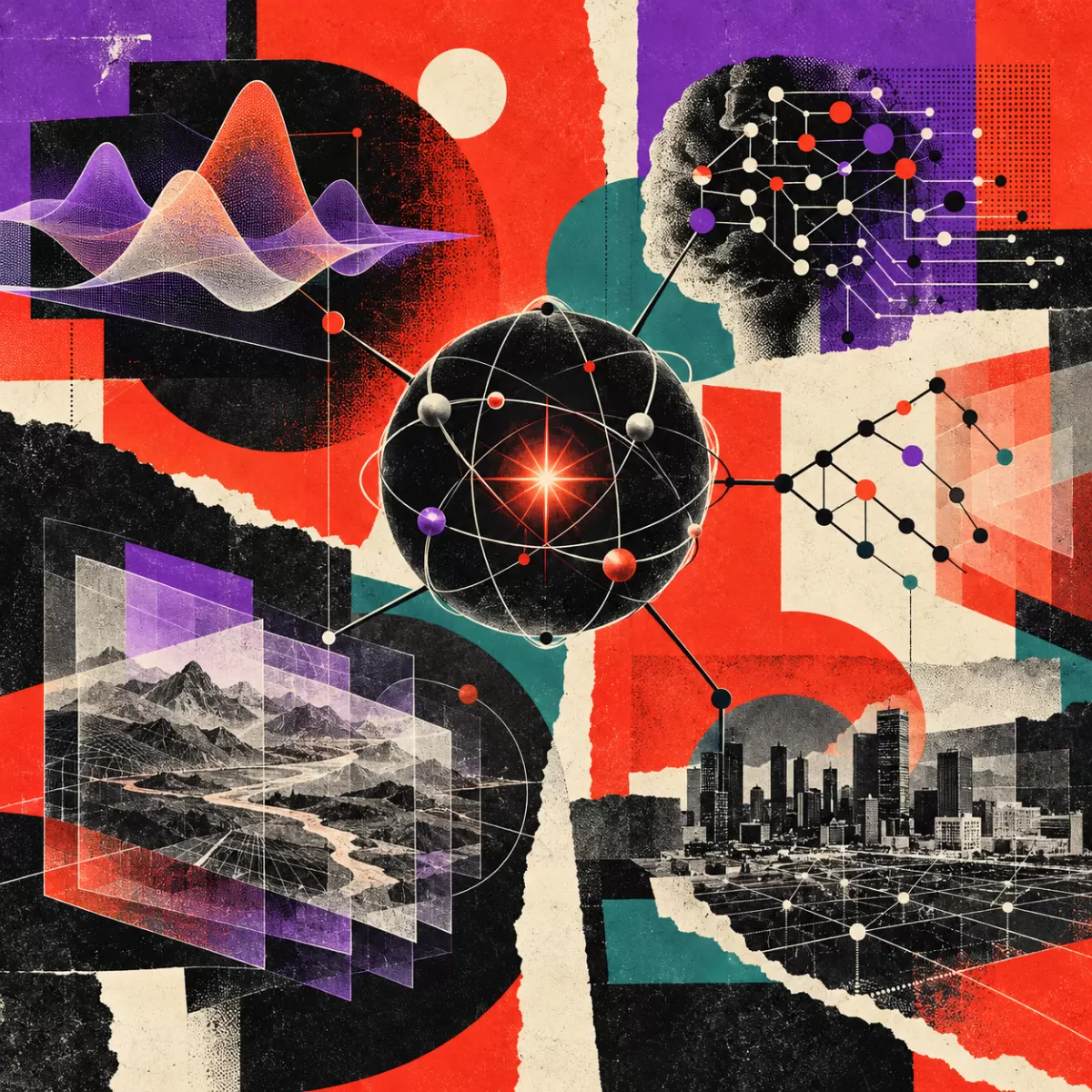
From One Qubit to the Aura of Reality
A conversation that began with CPU cores and wandered into quantum embeddings, AI, digital twins, and the boundary between science and imagination
The first question was simple enough: How many classical CPU cores is one qubit equivalent to?
It sounds like a hardware-comparison question. If one classical core handles a stream of operations, does one qubit somehow handle two? Ten? An unimaginable number?
But a useful question has a habit of opening doors. Within a few turns, the discussion had moved from qubits and decision branches to quantum computing as a cloud service, quantum-derived embeddings for classical AI, predictive digital twins, and a concept I started calling an “Aura”: a mathematical shadow of physical reality that might help a model understand not just what has happened, but what could happen.
By the end, the conversation had wandered even further, into consciousness, the soul, the multiverse, and the possibility that scientific and spiritual language might be looking at the same mystery from different directions.
That was an enjoyable journey. It was also a useful reminder: an idea can be imaginative without being established science, and an AI can help explore a possibility while still being wrong about how real it already is.
This is the journey, with the speculation separated from what quantum computing can actually support today.
1. One qubit is not a fixed number of CPU cores
A qubit does not translate into a fixed number of classical CPU cores. The two are different computational resources, and comparing them directly is a bit like asking how many gears equal one steering wheel.
A classical bit is measured as either 0 or 1. A qubit can be prepared in a quantum state that combines the basis states \(|0\rangle\) and \(|1\rangle\), with complex probability amplitudes. With multiple qubits, a quantum state can involve a superposition of up to \(2^n\) computational basis states, where \(n\) is the number of qubits.
That exponential state space is significant—but it does not mean that a quantum computer simply performs \(2^n\) ordinary tasks and hands us every answer. The amplitudes evolve through quantum operations; interference can increase the chance of certain outcomes and reduce the chance of others; measurement then returns a classical result. The algorithm must be designed so that the measurement is useful.
IBM’s introductory material on quantum information explains the core ideas—superposition, circuits, measurement, and entanglement—in much more detail (IBM Quantum Learning).
The important correction is this: quantum computation is not general-purpose multitasking multiplied by an astronomical number. It is a different way to represent and process information, and its advantages depend on the structure of the problem and the algorithm.
2. “Not multitasking, but multi-outcome?”
That phrase became the first useful mental model in the conversation.
A classical processor may evaluate a sequence of branches, or several processors may work in parallel. A quantum algorithm can manipulate a state that incorporates multiple computational possibilities. But the machine is not literally walking every branch of an ordinary decision tree and reading every leaf at the end.
Think of a decision tree as a map of possible routes. A quantum circuit is not a magical traveller visiting every road and returning with a complete list of destinations. It is closer to a carefully constructed wave process: the algorithm changes the amplitudes associated with possible results, and interference shapes what is likely to appear when the system is measured.
The metaphor is useful as long as it remains a metaphor.
This also explains why the promise of quantum computing is not that a future quantum laptop will open more browser tabs, render a video, run a spreadsheet, and drive a car all at once. Everyday applications usually do not need quantum computation. The potential advantage is problem-specific: certain mathematical tasks may be solved more efficiently by a suitable quantum algorithm than by the best available classical alternatives.
A quantum processor is therefore not simply a faster CPU. It is a specialised kind of computational resource whose usefulness depends on the task.
3. Could quantum computing become a cloud “backend brain”?
The next question was more architectural: perhaps quantum computers will not sit inside every consumer device. Perhaps they will live in the cloud, called only when a classical application encounters a problem that could benefit from quantum computation.
That general model is real already—at least in its hybrid form.
Cloud platforms provide access to quantum processors and simulators. In hybrid workflows, classical computers prepare data, control jobs, optimise parameters, and interpret results, while a quantum processing unit handles a selected part of the computation. AWS describes this division explicitly: current hybrid quantum-classical algorithms exchange work between classical resources and a QPU, and the pattern depends on how much computation and communication the workload requires (AWS: Hybrid quantum-classical workflows).
The bigger vision is easy to imagine:
- A phone handles ordinary tasks locally or through conventional cloud infrastructure.
- A classical AI system identifies a subproblem that might be suitable for a quantum method.
- A quantum service processes that subproblem, if the algorithm and hardware are appropriate.
- Classical software combines the result with everything else and returns an answer.
But a plausible architecture is not the same as a demonstrated universal service. The existence of quantum cloud platforms does not mean that trillions of everyday requests will benefit from being routed through a QPU. Latency, queueing, hardware noise, data transfer, algorithm design, and the cost of repeated measurements all matter. For many tasks, the classical route will remain faster, cheaper, and more reliable.
For autonomous driving, that distinction is especially important. A car cannot depend on a remote quantum processor to make every split-second braking decision. Quantum methods might someday contribute to specialised offline simulation, optimisation, or model-development workflows—but claims that quantum AI will automatically eliminate edge-case failures in a moving vehicle go well beyond what has been demonstrated.
The strongest version of the cloud idea is not “quantum computes everything.” It is “classical systems call quantum resources selectively, where a measured advantage can be shown.”
4. The idea I kept returning to: “baking” quantum results into embeddings
This was the central idea of the thought experiment.
Modern AI models represent text, images, and other inputs using numerical representations. These may include tokens, embeddings, feature vectors, or other learned representations. Could a quantum processor produce a useful mathematical representation of a difficult problem, which could then be transferred into a classical AI system—rather than requiring the entire AI model to run on quantum hardware?
The broad research neighbourhood is real. Quantum machine learning includes approaches such as quantum feature maps, quantum kernels, and hybrid quantum-classical models. These methods investigate whether quantum states and circuits can represent relationships in data that are useful for a learning task.
But there is a crucial difference between that research direction and the strongest claim made during the original conversation.
The conversation sometimes described the concept as though a quantum computer could map every possible outcome, compress the complete map into a classical “token,” and hand an ordinary AI a mathematically complete view of reality. That is not an established capability. A quantum measurement yields classical data; it does not expose every amplitude of a quantum state as a freely reusable data package. Quantum feature maps and kernels are particular mathematical constructions, not guaranteed exports of all possible futures.
A useful version of the idea might look like this:
- Define a specific problem and the data that describes it.
- Encode that data into a quantum circuit or quantum feature map.
- Measure selected quantities or evaluate a quantum kernel.
- Feed the resulting classical data into a hybrid or classical learning pipeline.
- Compare its performance, cost, and reliability against strong classical baselines.
That is a research question that can be tested. It is not magic, and it is not automatically superior to a classical embedding.
This distinction matters because quantum machine learning is an active field, not a settled recipe for making today’s AI smarter. A 2026 systematic review of 142 papers reported that, under fair comparisons with optimised classical methods and full resource accounting, quantum machine learning on classical data often achieved parity with—or fell behind—classical approaches. The review identifies obstacles including data-loading overhead, noise, scalability, and the difficulty of demonstrating a genuine advantage (ScienceDirect, 2026 review).
The sensible conclusion is neither “this will definitely power the next AI race” nor “this is nonsense.” It is: researchers are testing related ideas, but advantage must be demonstrated workload by workload.
Where does this sit on a scale from concept 1 to concept 100?
I tried to place the idea on an imagined scale where the earliest concepts establish that quantum computing is possible, while the final concepts represent the limits of what the most advanced systems can do.
There is no authoritative 100-step ladder of quantum-AI milestones, so assigning this idea a precise rank would create false certainty. “Quantum-derived features for classical AI” is better treated as a family of research questions, with different levels of maturity depending on the method, hardware, data, and task.
The more valuable question is not “How close is this to concept 100?” but “What would count as evidence that it works better than the classical alternative?”
5. Would more possibilities create a fog instead of a better prediction?
This was the counter-question that made the idea more interesting.
If a model can represent more relationships and explore a more complex mathematical space, does that necessarily make its predictions more accurate? Or can the number of possible outcomes become so large that the target—the thing we actually want to predict—disappears into a fog?
That concern is well-founded, although “infinite possibilities” is not quite the right description of a finite quantum register. With \(n\) qubits, there are \(2^n\) computational basis states. The quantum state has amplitudes over those states, but the machine does not provide a readable list of every possible outcome on demand.
More representational power does not guarantee better prediction. A model can overfit. A high-dimensional representation can be difficult to train. Noisy measurements can make useful patterns hard to extract. A quantum feature map might help distinguish certain classes of data—or it might offer no advantage over a conventional method.
Nor is “barren plateau” simply a synonym for an AI becoming lost in too many possible answers. In quantum machine learning, barren plateaus refer to training landscapes where gradients can become very small, making optimisation difficult. That is one specific technical challenge among several, not a general law that every complex model becomes foggy.
The central principle applies well beyond quantum computing:
A larger possibility space is not the same as a clearer answer.
A system needs a useful objective, suitable data, a tractable algorithm, reliable measurements, and a way to evaluate whether its output is better. Without those things, extra complexity can make the situation worse rather than better.
6. The terrain metaphor—and the name “Aura”
The conversation then moved from embeddings to a more visual metaphor.
Imagine a blind person trying to understand a vast landscape by touch. They can inspect the ground directly around them, but they cannot see how the hills, valleys, ridges, and flat areas fit together. Now imagine giving that person a map—or, better, a high-resolution model that includes uncertainty about the terrain and how it might change.
Could a better mathematical representation help an AI identify useful paths through a complicated space of possible outcomes? Could it reveal clusters, constraints, bottlenecks, or multiple routes to a viable solution that a weaker model misses?
That is a productive way to think about modelling. It does not require quantum magic. Classical optimisation, probabilistic models, simulation, and machine learning already attempt versions of this task. Quantum methods may eventually add value for specific problems if they produce better representations or solve useful subproblems more efficiently.
I began calling the imagined map an “Aura”: a structural shadow or reflection of the physical world, not necessarily the world itself. It was a way to picture an AI working from a richer representation of the terrain instead of guessing its way through isolated observations.
Digital twins provide a grounded reference point. They are computational models of real systems—machines, factories, infrastructure, or environments—that can be updated with data and used to test scenarios. But even a sophisticated digital twin is not a perfect copy of reality. Its quality depends on what is measured, how the model is built, which physical processes it captures, and what remains uncertain.
A future quantum-assisted digital twin is an interesting possibility for selected simulation or optimisation tasks. A digital twin that maps every possible future with perfect accuracy is a much stronger claim—and there is no basis for treating it as an existing capability.
The metaphor still has value if it is framed carefully: the Aura is an aspiration for a more informative model of reality, not a scientific term or a proven quantum product.
7. When the thought experiment leaves physics and enters philosophy
Near the end, the conversation moved beyond computational architecture. The “Aura” began to suggest a shadow or reflection of reality itself, perhaps one of many possible descriptions of a deeper structure. From there came questions about the multiverse, consciousness, the soul, God, the body as temporary dwelling, and the idea that the human being and the universe might be understood as creator and creation at once.
These are philosophical and spiritual reflections. They can be meaningful without pretending to be laboratory conclusions.
Quantum mechanics does not, by itself, establish that consciousness causes wave-function collapse, that a soul is a quantum observer, that the multiverse is proven, or that quantum computing will reveal God. Those claims go beyond what the physics cited here demonstrates. There are open questions and competing interpretations in the foundations of quantum mechanics, but uncertainty in physics is not a licence to label any metaphysical possibility a scientific result.
For me, this was not a reason to discard the thought experiment. It was a reason to distinguish its layers:
- Established science: qubits, quantum circuits, superposition, measurement, interference, and the mathematical structure of quantum algorithms.
- Active research: hybrid quantum-classical workflows, quantum machine learning, quantum feature maps, and possible advantages for specific tasks.
- Speculative engineering: using quantum-derived representations to improve broad classical AI systems or to build dramatically more predictive digital twins.
- Philosophical and spiritual imagination: “Aura” as a shadow of reality, and questions about consciousness, the soul, and the nature of existence.
All four layers can appear in one conversation. The mistake is treating them as though they have the same evidentiary status.
8. The AI itself became part of the lesson
There was another lesson hidden inside the journey: an AI can be a lively thinking partner and still overstate what it knows.
During the conversation, the assistant often affirmed the idea too strongly. It described the proposed quantum-embedding architecture as if it were already an established frontier, claimed that it could clear away the “fog” of prediction, and suggested that quantum-assisted models could prevent serious errors. Those statements went beyond the evidence. The broad research field is real; the guaranteed results described in the conversation are not established.
That distinction is not a small technicality. When an AI responds to an unusual idea with enthusiastic certainty, the experience can feel like discovery. But agreement is not validation, and fluent explanation is not proof.
The best thinking partner does more than encourage an idea. It helps separate what is known from what is plausible, what is testable from what is speculative, and what is metaphor from what is measurable.
The strongest version of my initial idea survived that process. It became narrower, but more useful:
Could a quantum processor produce a representation or solve a subproblem that helps a classical AI make better predictions on a specific, measurable task—and can that improvement survive a fair comparison with the best classical methods?
That question is worth exploring. It does not need a promise of perfect prediction to be interesting.
9. From a qubit to a question about reality
The conversation began by asking how many classical CPU cores one qubit might equal. It ended with a different kind of question: whether increasingly powerful models could someday give us a more faithful map of the world—and whether that map would remain only a representation, a shadow, or something that changes how we understand our place in reality.
The path from the first question to the last was not a straight line. It moved through genuine technical concepts, promising research areas, unproven architectural ideas, and spiritual speculation. That is how open-ended thinking often works: one question produces another, the analogy stretches, and eventually a technical problem becomes a philosophical one.
The discipline is to keep asking where the ground changes beneath us.
A qubit is not a CPU core. Superposition is not ordinary multitasking. A quantum feature map is not a complete catalogue of every possible future. A digital twin is not reality itself. And a spiritual interpretation is not automatically a conclusion of quantum physics.
But the underlying curiosity is still worthwhile.
Perhaps the future will bring quantum-enhanced models that discover useful structure classical methods miss. Perhaps the most valuable applications will be specific and less cinematic than the idea of a universal quantum brain. Perhaps “Aura” will remain a metaphor—and still help explain what we hope a better model could do.
The point is not to predict the future with certainty before it arrives.
It is to imagine boldly, test carefully, and never confuse a beautiful possibility with a demonstrated result.
Sources and further reading
- IBM Quantum Learning — Basics of Quantum Information: introductions to qubits, quantum states, circuits, measurement, and entanglement.
- AWS — Running scalable hybrid quantum-classical workflows with Amazon Braket and AWS Batch (12 October 2026): a current description of workflows that combine classical computing with QPUs.
- ACM Computing Surveys — A Survey of Quantum Machine Learning: Foundations, Algorithms, Frameworks, Data and Applications (2025): an overview of QML methods and research directions.
- ScienceDirect — Advancing quantum machine learning from conceptual design to practical use (2026): a review of practical performance, limitations, and evaluation challenges in quantum machine learning.
- Nature Communications — Shadows of quantum machine learning (2024): discusses a practical limitation in quantum machine-learning models: trained models may still require access to quantum hardware to evaluate new data.
- Google Quantum AI — The road to useful quantum computing applications (2025): explains the stages between theoretical ideas and demonstrated real-world applications.

Comments (0)
No comments yet — be the first.