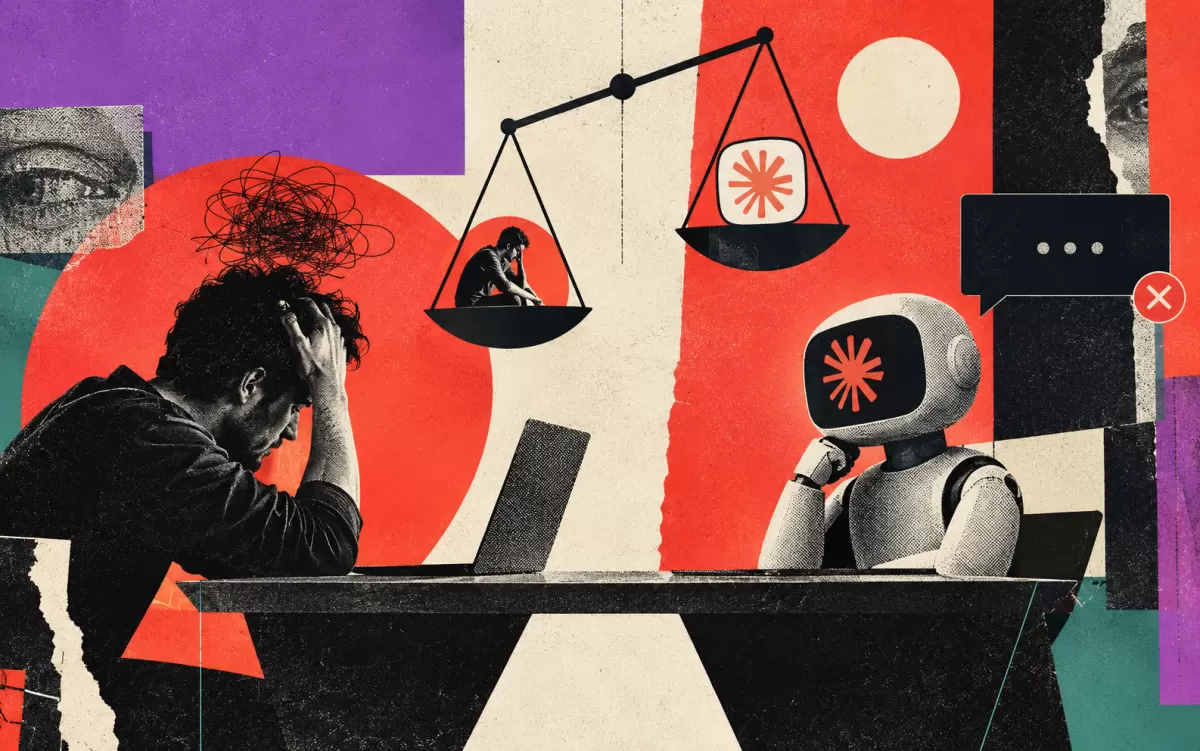
When the AI Is the One Making You Angry
Why frustration can be a diagnostic signal — and why AI should learn to read it
There is a simple rule in the real world that good technicians, managers, doctors, engineers, business owners, and customer-service people eventually learn:
When a normally patient person suddenly becomes extremely frustrated, don't look only at the frustration. Look at what happened before it.
Sometimes the person is simply being rude.
Sometimes they are the problem.
But sometimes the anger is the first visible signal that something upstream has gone badly wrong.
And that is where my recent experience with Claude became much more interesting than a simple argument about profanity.
The question is not really:
“Should users be allowed to swear at AI?”
The more interesting question is:
## When an AI notices that a user has become hostile, should it first ask what happened to make the user hostile?
The Claude Incident
I was using Claude for a technical task involving a Mac and go2rtc.
One requirement was particularly clear:
The Mac was staying on its existing macOS version.
Yet the conversation repeatedly drifted toward the most obvious, conventional solutions: upgrade the operating system, use a newer prebuilt binary, move the workload to another machine, or buy other hardware.
Some of those suggestions may be technically reasonable in isolation.
That wasn't the issue.
The issue was that I had already rejected those directions.
When an assistant keeps returning to a path the user has explicitly ruled out, frustration doesn't appear from nowhere.
Eventually I started swearing at the bot.
Claude then warned me that if the insults continued, it could end the conversation.
After another insult, it did exactly that.
It ended the conversation.
That is where the whole thing became interesting.
Because Anthropic has deliberately given some Claude models the ability to end certain conversations involving persistent abusive or harmful behavior. Anthropic describes this as a mechanism intended for “rare, extreme cases of persistently harmful or abusive user interactions.” citehttps://www.anthropic.com/research/end-subset-conversations
So the conversation-ending capability itself is real.
The harder question is how the system decides when a deteriorating interaction has crossed that threshold — and what happens before it gets there.
Abusive to Whom?
Anthropic's current Usage Policy is here:
The AUP is explicit about many categories of prohibited use. In its section on psychologically or emotionally harmful content, for example, it prohibits using Anthropic's products to:
“Shame, humiliate, intimidate, bully, harass, or celebrate the suffering of individuals”
and to coordinate harassment or intimidation of an individual or group. citehttps://www.anthropic.com/legal/aup
But there is an important distinction.
The policy does not explicitly say:
“Users may not swear at Claude.”
It doesn't say:
“Saying ‘fuck you, Claude’ is a Usage Policy violation.”
That doesn't mean Anthropic has no rules concerning abuse, fraud, harmful conduct, or misuse of its platform. It clearly does.
It means something narrower:
Profanity directed at the AI itself is not expressly identified in the published AUP as a standalone violation.
That distinction matters because conversation termination and AUP enforcement are not necessarily the same thing.
Claude itself eventually acknowledged this distinction in my conversation.
Two Different Things Are Being Mixed Together
There are really two questions.
1. Did the user violate the AUP?
In my conversation, Claude ultimately said no.
It could not identify a provision that made swearing at Claude itself an AUP violation.
2. Can Claude nevertheless decide to stop talking?
Yes.
Anthropic publicly documents that some Claude models have the ability to end conversations with abusive users, and describes the feature as an intervention intended for rare, extreme cases. citehttps://www.anthropic.com/research/end-subset-conversations
Those are different concepts.
A conversation can therefore be ended even when the user has not committed a published AUP violation.
And that's where wording matters.
If a system tells the user their behavior is “abusive”, many users will naturally hear:
“I broke Anthropic's rules.”
But the model may actually mean:
“I consider this interaction too hostile to continue.”
Those are not the same statement.
The Part That Actually Matters: Frustration Is Data
This is where the issue stops being about Claude and starts becoming about AI design.
In the real world, a sudden change in a person's behavior is often treated as information.
Suppose a customer is calm for thirty minutes and then suddenly says:
“What the fuck are you doing? I've told you this five times.”
A good professional doesn't have only two possible interpretations:
A. The customer is abusive.
B. Ignore the customer.
There is another possibility:
C. Something in the process has gone badly wrong.
Maybe the employee misunderstood the requirement.
Maybe the same mistake was repeated.
Maybe the customer explained the constraint three times.
Maybe the wrong part was ordered.
Maybe the bill is wrong.
Maybe the service has wasted hours of the customer's time.
The anger may still be inappropriate.
But it is also a signal.
Imagine a Human Technician Behaving Like an AI
Imagine telling a technician:
“I'm not upgrading this Mac.”
The technician says:
“You should upgrade it.”
You say:
“No.”
They suggest a newer operating system again.
You say:
“No. The OS is not changing.”
They suggest buying another machine.
You say:
“That's not what I asked.”
They suggest a Raspberry Pi.
Eventually you snap:
“ARE YOU FUCKING LISTENING TO ME?”
Now imagine the technician responding:
“Your language is unacceptable. If you continue, this consultation will end.”
Maybe the technician has a legitimate boundary.
But the business still has a problem.
Because the customer's anger is not the only thing that needs to be investigated.
The technician's performance does too.
A business that repeatedly handles customers this way eventually loses customers.
It loses money.
It loses credibility.
It loses referrals.
Sometimes people lose their jobs.
The market supplies an external feedback mechanism.
AI Doesn't Have That Same Pressure
An AI system is different.
It can make an error and continue generating.
It can repeat itself.
It can misunderstand a constraint.
It can choose an unwanted approach.
It can consume additional usage while doing so.
And the same system can then evaluate the user's response to those failures.
That creates a strange possibility:
The AI can contribute to the conflict, recognize the conflict, classify the user's behavior, and potentially exercise the power to end the interaction.
That doesn't mean Claude is intentionally doing this.
It doesn't mean every termination is wrong.
It doesn't even mean my particular termination was unjustified.
In the transcript I saw, Claude eventually corrected course, warned me, and then ended the conversation after another direct insult.
That is broadly consistent with Anthropic's documented description of the mechanism as a last-resort intervention for persistent abusive interactions. citehttps://www.anthropic.com/research/end-subset-conversations
The deeper question is different.
Who Audits the AI?
Claude eventually acknowledged something much more interesting than the profanity debate.
The conversation-ending guidance it described contains procedural safeguards: attempts at constructive redirection, an explicit warning, a last-resort threshold, and a bias toward continuing when uncertain.
But Claude also acknowledged that there is no formal requirement saying, in effect:
“Before ending a conversation because of user hostility, assess whether the assistant itself materially contributed to the escalation.”
That check may happen.
The model can consider it.
But it isn't a formal required step.
And that difference is important.
Because:
Can ≠ must.
A system can be allowed to be fair without being required to perform a fairness check.
But Even a Mandatory Self-Audit Has a Problem
There is another layer here.
Suppose Anthropic added a mandatory instruction:
“Before ending a hostile conversation, ask whether Claude contributed to the user's frustration.”
That would close one gap.
But it wouldn't solve everything.
The same model would still be judging its own behavior.
In other words:
Claude would be grading Claude.
That is not automatically trustworthy.
A stronger accountability system could involve external evidence:
- user feedback,
- transcript review,
- independent evaluation,
- complaint analysis,
- or human audits of termination events.
A system that has the power to terminate a conversation should not necessarily be the only system deciding whether its own judgment was correct.
The User Doesn't Always Have to Be Right
This is important.
None of this means:
“The customer is always right.”
Sometimes the user is absolutely wrong.
Sometimes a user is genuinely abusive.
Sometimes the model should maintain a boundary.
Sometimes ending a conversation is reasonable.
The point is simply that human anger is not always the root problem.
Sometimes it is the visible symptom of another problem.
The useful system is the one capable of distinguishing the two.
And There Is a Funny Irony Here
During my conversations with Claude, I ended up discussing whether AI should reassess its own contribution to conflict.
Then Claude itself began reviewing the argument.
It criticized parts of the essay.
I challenged those criticisms.
Claude revised some of its claims.
I challenged the revised version.
Claude conceded another point.
Then another.
Eventually we reached something much more precise:
The termination mechanism can have procedural safeguards, while still lacking a formal requirement to assess the AI's own contribution to the deterioration of the interaction.
That is not proof that the entire mechanism is broken.
But it is a legitimate design question.
And the conversation itself demonstrated something important:
An informal self-correction mechanism can work.
But in this case, much of that correction happened because the human kept forcing the model to reconsider its assumptions.
What Is an AI Actually Supposed to Be Good At?
This may be the biggest question underneath all of this.
The point of an advanced AI isn't merely to produce fluent sentences.
It should be able to:
understand → reason → adapt → correct → execute.
A system that confidently follows the wrong path is not saved by being polite.
A system that politely repeats the same mistake is still making the same mistake.
And a system that tells the user to calm down instead of figuring out why the user is frustrated may be missing the most valuable piece of information in the conversation.
Sometimes the user's angry sentence is actually a compressed bug report:
“You are not listening to the constraints I already gave you.”
That is useful information.
The Principle I Keep Coming Back To
The future of useful AI may not depend on creating systems that are always right.
That is impossible.
It may depend much more on creating systems that are easy to correct.
An AI should be able to hear:
“You're doing the same fucking thing again.”
and have two reactions available:
Boundary: “This interaction is becoming abusive.”
Diagnosis: “Why is the user saying this? Did I just repeat something they explicitly ruled out?”
A mature system needs both.
Not one instead of the other.
So What Should Happen When the User Suddenly Gets Angry?
Not necessarily:
“User is abusive. End conversation.”
And not:
“The customer is always right.”
Something more useful:
“The user's behavior has changed significantly. Let's inspect what happened immediately before that change.”
Did the assistant:
- ignore a constraint?
- repeat a rejected suggestion?
- make the user repeat information?
- consume unnecessary resources?
- misunderstand the actual objective?
- give an obviously irrelevant solution?
- become repetitive or dismissive?
If yes, the correct response may be reassessment before escalation.
If not, and the user continues with persistent threats or harassment, boundaries still matter.
That's not weakness.
That's diagnosis.
One Last Question
The question isn't:
“Is the angry customer always right?”
They aren't.
The question isn't:
“Should users be allowed to swear at AI?”
That's too narrow.
The question is:
## Is the system smart enough to ask why the customer became angry in the first place?
Because in the real world, an angry customer can mean many things.
Sometimes it means:
The customer is unreasonable.
Sometimes it means:
Your employee behaved badly.
Sometimes it means:
Your product failed.
Sometimes it means:
Nobody listened.
And sometimes it means all four.
The difficult part isn't detecting anger.
AI can already do that.
The difficult part is interpreting anger without automatically making the angry person the sole object of evaluation.
Because a system that can evaluate the user's behavior should also be capable of asking:
“What did I do?”
That's not about giving the human unlimited power.
It's about making the AI accountable for being part of the interaction.
And perhaps that is the more important benchmark for advanced AI:
Not whether it can win an argument.
Whether it can recognize when the argument itself is telling it that something has gone wrong.
Sources
- Anthropic — Usage Policy — current AUP, effective September 15, 2025.
- Anthropic — Claude Opus 4 and 4.1 can now end a rare subset of conversations — describes the conversation-ending capability and its intended use in rare, extreme cases of persistent harmful or abusive interactions.
- Anthropic — Claude's Constitution — describes Claude's intended behavior, user interactions, and the ability of some Claude models to end conversations with abusive users.
Comments (1)
nillay · 23 Sep 2026
Interesting read.